Transformative Changes
for Biodiversity and Health
An Alternet Conference in Ghent, Belgium
14 – 17 June 2022
Changes in land and sea use, overexploitation, climate change, pollution and invasive alien species mean that nature is rapidly disappearing, posing significant challenges to human and ecosystem health. Nature is as important to our mental and physical well-being as it is to our society’s ability to cope with global change, health threats and disasters. Protecting and restoring biodiversity and functioning ecosystems is therefore essential to building our resilience. The call for transformative change is an absolute necessity to halt and eventually overcome the biodiversity and climate crisis. This is now recognised and integrated into many member states and EU’s biodiversity strategies, as well as at the global level by IPBES and the CBD.
Where and why do the benefits of biodiversity for ecological and human health arise and how can they be achieved? How and where can transformative change enable these benefits, including ensuring justice and equity? How can human-nature health solutions be developed? How can the adoption of these transformative biodiversity and human health solutions by society and communities be achieved, for example by transforming food systems?

The Alternet 2022 conference aims to address these questions by focusing on what interdisciplinary biodiversity research can contribute to the transformative change agenda in biodiversity and health. It will offer new perspectives on research and policy as well as practice, highlight information needs and develop partnerships to advance our knowledge on biodiversity and health.
Given the breadth and depth of current and impending crises and the links between human health and biodiversity, it is time for a radical transformation of socio-ecological structures towards a vision of sustainability and resilience – one that enhances the well-being of humans and the biosphere as a whole. Mobilising scientific research, interdisciplinarity and co-construction with stakeholders and decision-makers is the way forward.
Alternet bridges disciplines and connects science and policy to the challenges of societal sustainability because we believe that the greatest innovation for societal impact can be achieved by science through unusual collaborations in practice.
Who attended this event?
Contributors and attendees included researchers, scientists, decision-makers, and practitioners of all disciplines, including key personnel from Europe’s science-policy interface on biodiversity and ecosystem services.
Outputs
Presentations
Keynotes
- Peter Bridgewater – Having a whale of a time with transformative change
- Eeva Furman – Why a project called Bio-Agora is needed?
- Jiska van Dijk and Heidi Wittmer – Aspirations versus reality in transformative change
- Hilde Eggermont – Biodiversa+: Strengthening the knowledge foundations for societal transformation
- Serge Morand – Biodiversity and Health
Session 1
- Marc Deconchat – Biodiversity and health as a framework for assessing pesticides in agriculture
- Andrea Franke – Why and how to achieve ocean health?
- Armand Okende – Identification of the drivers of deforestation in the Democratic Republic of Congo: case of the territory of Bolobo
Session 2
- An Cliquet – Towards an explicit legal recognition of the link between biodiversity and human health
- Lars Berger – Facilitator or recipient? The role of nature conservation in Transformative Change
- Matthias Steinparzer – Integrating tree species identity and diversity in particulate matter absorption
Session 3a
- Myriam Dumortier – Sharing (sub)urban protected areas – the agro-ecological farmers’ perspective
- Martin Wildenberg – Transformation for the mass markets: Farmers, retailers and the agro-ecological transformation – Lock-in or lever?
Session 3b
- Elisa Bohin, Murielle Trouillet – PREZODE: Preventing zoonotic disease emergence
Session 3c
- Giorgia Dalla Libera Marchio – Public Food Procurement as driver of Food Systems Transformation
- Tamara Bruning – Sustainable criteria in food tenders: City of Ghent
Session 4
- Austin Martin – Biodiversity in Cities: How urban pollinators show the importance ofrobust political ecological theory
- Lisa Norton – The role of ruminants in future food systems
- Francesca Leucci and Eleonora Ciscato – Fifty Shades of Restoration in Italy: an Analysis of Legal Tools and Drivers for Transformative Change
- Hugo Enrique Reyes Aldana – Can combining functional and structural metrics help to develop better assessments of ecosystem health?
Session 5
- Päivi Sieppi – Nature Step to Health: A multisectoral programme to public health and environmental work in Lahti region
Session 6
Session 7
Session 8
- Laura Wendling – Monitoring and Evaluation of Nature-Based Solutions
Session 9
- Bede West – A hard rain’s gonna fall: How do deliberate and ‘accidental’ nitrogen inputs highlight interconnection in grasslands?
- Maria Haensel – Can a regional diet be nutritionally healthy and environmentally friendly? – a case study for Bavaria
- Wessel Ganzevoort – Caring for and about birds: Relational values in birders’ stories about their passion
Session 10
Session themes
Biodiversity and Ecological Health
Biodiversity and Human Health
Transforming Food Systems
How to research transformative changes
Actionize scientific knowledge (science policy interface)
Governing system-level risks: connecting human and environmental health with other sustainable development goals
Invasive species and their impact on human and ecosystem health
Making cities biodiverse – co-benefits for people and nature
Transforming our perceptions of Human-Nature relationships for transformative change
Transdisciplinary education: A leverage point for transformative change
Programme and Speakers
Keynote speakers:
● Peter Bridgewater (University of Canberra): Having a whale of a time with transformative change.
● Serge Morand (CNRS – CIRAD, France): The links between biodiversity, health and epidemics.
● Nicolas Dendoncker (Department of Geography, Transitions Institute, University of Namur, Belgium): Transforming food systems and rural areas.
● Heidi Wittmer (Helmholtz Centre for Environmental Research – UFZ) and Jiska van Dijk (NINA): Aspirations versus reality in Transformative Change.
● Eeva Furman (Finnish Environment Institute – SYKE): BioAgora.
● Hilde Eggermont (Affiliate at Royal Belgian Institute of Natural Sciences, Coordinator & Chair of the European Biodiversity Partnership – Biodiversa+): Biodiversa+ (The European Biodiversity Partnership):
Strengthening the Knowledge Foundations for Societal Transformation.
Practical Info
Location: Augustinian Monastery – Ghent, Belgium
Date and Time: 12:00, 14 June – 12:00, 17 June 2022
Contact: secretariat@alterneteurope.eu
Address:
Augustijnenklooster St-Stefanus
Academiestraat 1
9000 Gent
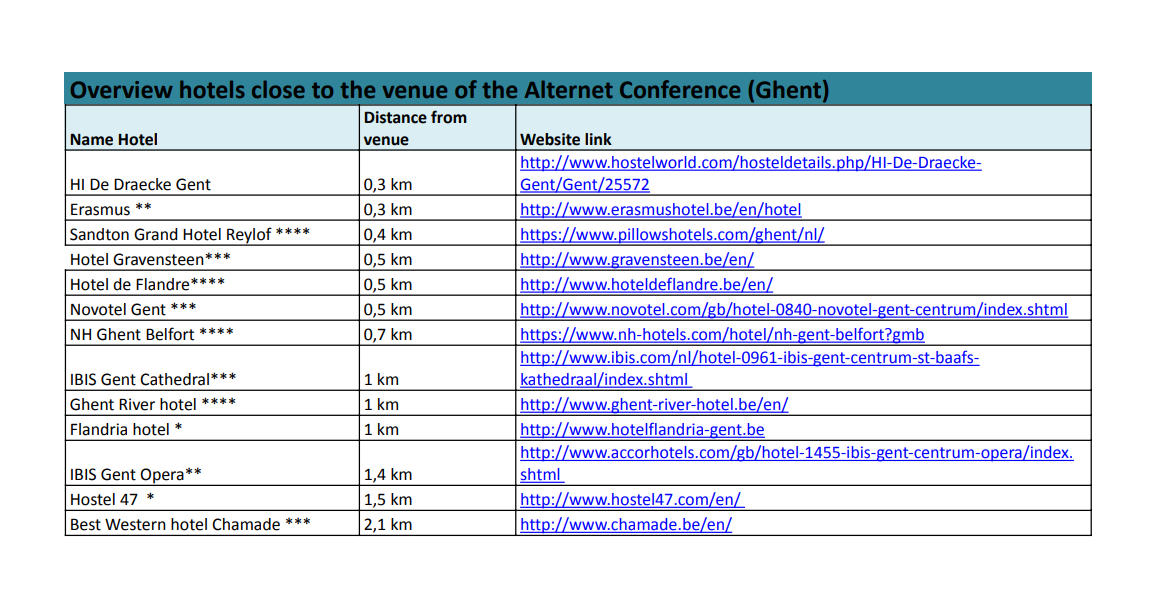
Hotel & Accommodation Recommendations
Travel Tips
It takes approximately 30 minutes to travel to Ghent from Brussels by train–over a distance of around 30 miles (49 km). There are normally 79 trains per day traveling from Ghent to Brussels and tickets for this journey start from €11.20 when you book in advance.