

Science-Policy Interface
The SPI One-Stop-Shop
A window into Europe’s science-policy interface landscape


SPI Overview
What they are–and what they aren’t
Conservation of biodiversity and ecosystem services implies human action, and as such potentially all biodiversity conservation research is policy relevant.
But all too often as scientists we develop research that we think should be interesting to and integrated into policy, but actually is not relevant either at that time, or in the format we envisage (be in the way in which we are formulating the question, or the way in which we hope to answer it).
In other words, all too often we develop research that we then try and force into policy processes, much like forcing a square peg into a round hole. Whilst we may think this gives us some sort of purpose, it can be very frustrating for researchers who want to engage in the Science-Policy Interfaces (SPIs) and can’t.
There is also the issue that not all researchers involved in biodiversity conservation need to engage in science-policy interfaces on all aspects of their research. But for the purposes of this one-stop-shop, we will focus on how SPIs can work, and how researchers can get engaged in these processes.
It is important to start with what SPIs are, but also to stress what SPIs are not (see the SPIRAL myth-busting guide). Science-Policy Interfaces are all the ways in which scientists, policy-makers and other actors link up to communicate, exchange ideas and develop knowledge jointly to enrich policy and decision-making processes and/or research (van den Hove, 2007, SPIRAL). Science and policy are not independent domains of human activity, it is not about a one-way flow in which science speak truth to power, and SPIs are not simple fora where scientific knowledge lead to policy in clear and controllable ways.
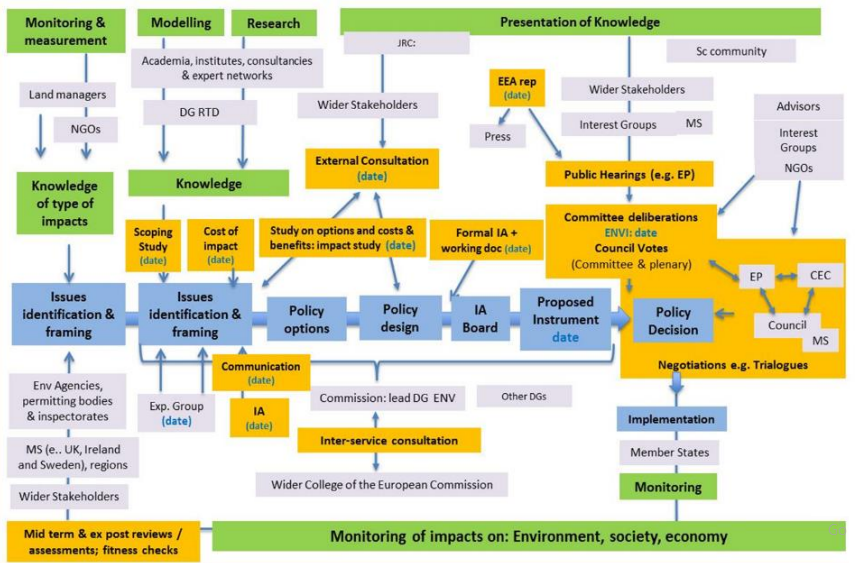
The reality is that SPIs are often messy and difficult, but a positive is that the challenges around SPIs are now well known. As researchers we are dealing with environmental issues around biodiversity and ecosystem services, which are complex social-ecological systems. Scientific experts are not always best placed to communicate their work, and scientific work can get distorted through social media and other indirect routes. The policy setting is often complex, with multiple possible entry points, making it difficult for scientists to understand where they can contribute and how. And we still have silos both in terms of scientific disciplines, and in terms of policy sectors – making it difficult to see where we fit.
As researchers, there are inevitable trade-offs with engaging in SPIs:
- Clarity-Complexity trade-off (Simple messages vs. communicating uncertainty)
- Speed-Quality trade-off (Timely outputs vs. in-depth quality assessment)
- Push-Pull trade off (Supply-driven vs. demand-driven research)
- Personal Time trade-off (Interfacing vs. doing other things).
All this begs the question of “Why bother?”. Because huge amount of science that is potentially useful to policy is under-used. There is an accountability issue with funders increasingly demanding policy impact. Engagement in science-policy processes gives researchers better awareness of what research is policy relevant and, therefore, increases funding competitiveness. And finally, engaging in SPIs can be very satisfying and challenging (in a good way!).
Complex policy setting
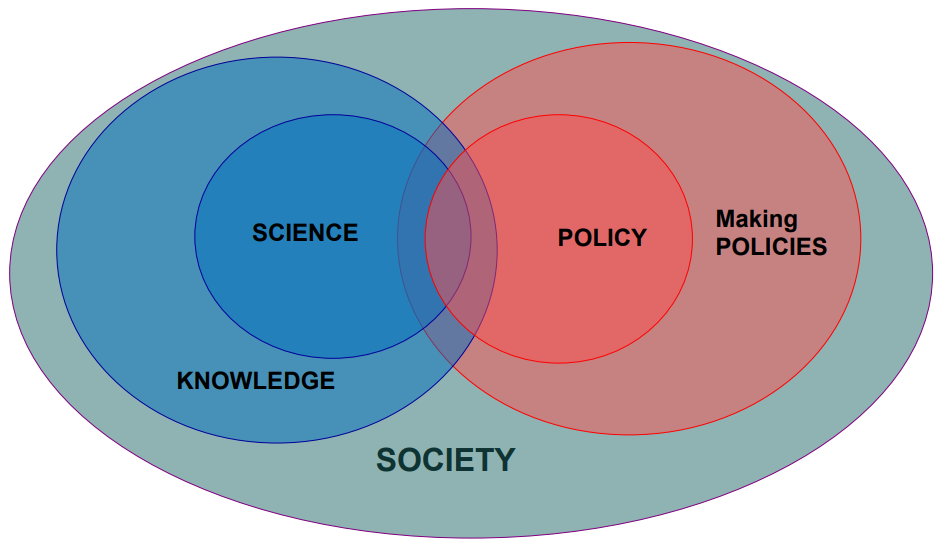
Q: What are science-policy interfaces?
A: The ways in which scientists, policy-makers and other actors link up to communicate, exchange ideas and develop knowledge jointly to enrich policy and decision-making processes and/or research (van den Hove, 2007, SPIRAL)
The SPI Landscape
And how to get engaged
Are you a scientist, either directly involved in SPIs (including SPI work packages within a project), writing a proposal involving an SPI, or just interested in SPIs and wanting to contribute to policy? Are you a decision-makers wanting to learn about biodiversity and SPIs or developing an SPI? A research funder or proposal evaluator concerned with the policy relevance of research? A translator–or any other key knowledge holder?
Actors of all these profiles (and more) can benefit from learning about the SPI landscape and identifying opportunities for learning and involvement. Some common motivators include:
- The massive amount of science that is potentially useful to policy but is currently under-used
- Accountability issue with funders increasingly demanding policy impact
- A need for better awareness of what research is policy relevant and, therefore, increases funding competitiveness
- A desire for increased impact of work–and a greater sense of purpose
Engagement guidelines
Are you ready to dive into the SPI landscape? Understanding the guidelines of SPI engagement will help to ensure that you are properly informed and equipped.
Originally compiled by the SPIRAL project, the following briefs cover a broad range aspects related to biodiversity science-policy interfaces, from understanding science-policy interfaces and biodiversity, to help on developing them. Read the ones most relevant for your work. Upgrade your knowledge–and equip yourself for SPI success!
Opportunities
for SPI involvement
- BioAgora is inviting experts on research prioritisation and consultation methods to join an expert panel to respond to a European Commission (EC) knowledge request and develop a framework for prioritising biodiversity knowledge gaps. Learn more and apply.
- UN CBD Expert Database: Are you actively involved in processes, biodiversity science, policy and implementation related to the Convention on Biological Diversity? Do you come from the EU or its Associated Countries? If your answer to these questions is yes, CO-OP4CBD invites you to join its newly launched UN CBD expert database! Learn more and register.
SPIRAL – SPI Briefs
Understanding science-policy interfaces
- A myth-busting-guide to science-policy interfaces (SPIs)
- Useful references on science-policy interfaces
Understanding biodiversity
- A beginner’s guide to understanding challenges of communicating about biodiversity (FR)
- What’s so special about biodiversity?
Improving communication
- General recommendations for improving science-policy communication
- Recommendations for improving science-policy communication for individuals
- Recommendations for improving science-policy communication for teams
- Recommendations for improving science-policy communication at the level of organisations
Strengthening science-policy interfaces
- SPI under the spotlight: ways to think about science-policy interfaces
- Key features of effective SPIs
- Designing for success: SPI structures
- Goals and roles: SPI objectives and functions
- Science-policy interface processes: fitting activities to evolving contexts
- SPI it out: making a splash with outputs
- Focus on impact
- Adding and sustaining the value of research: recommendations for research funding institutions
- Integration of research results into policy making: recommendations to policy makers
- Improving the use and impact of your research: recommendations to EU research projects
Integrating credibility, relevance, legitimacy and iterativity
- Keep it CRELE: credibility, relevance and legitimacy for SPIs
- CRELE Choices: trade-offs in SPI design
- Iterativity and dynamism in science-policy interfaces
Learning from existing science-policy interfaces
- Reality check for science-policy interfaces
- Reflections on recent experiences with the UK National Ecosystem Assessment
- An emerging multi-level and multi-function SPI for the implementation of the Water Framework Directive in Romania
- Co-constructing INBO’s policy relevance
- Recent reflections on science-policy communication in the context of deer management in Scotland
- Reflections on recent experience with the Water Framework Directive in Scotland
- Reflections on Science-Policy Interfaces in the development of National Biodiversity Strategies
- Tools for Science-Policy Interfaces: Recommendations on BISE and Eye on Earth
- Towards strengthening environment science-policy interfaces at EU-level: the SEPI exploration
- Afribes: Towards a social network of scientific and technical information for Africa
- The Economics of Ecosystems and Biodiversity – TEEB
- Spiraling IPBES
Moving from interfaces to alliances
Briefs in French

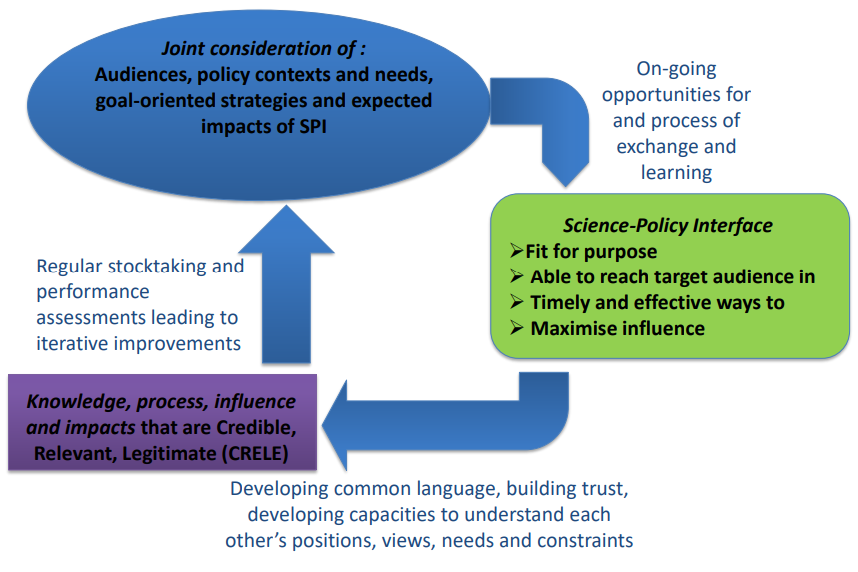
The process of framing with policy and other decision-makers:
• Ensures an understanding of the policy or societal need
• Requires communicating what research can and can’t do
• Enables joint decisions on research questions, approaches and outputs
• Requires regular stock-taking
SPI Success
Sharing experiences, resources, and support
The SPI community is just that–a community, made up of individuals of all levels of experience and covering the full spectrum of specialties and areas of interest. Take full advantage of the resources this diverse SPI community offers! Below, you can use our exchange platform to compare and contrast experiences with SPI peers; and our expert outreach platform to seek out guidance from Eklipse team experts.

Share your experience
Have you worked (or attempted to work) with SPIs? Share your SPI engagement experiences on our exchange platform! Young researchers are especially welcome.
Contact an SPI expert
Eklipse personnel can provide you with expert guidance, specific information, and SPI support.
SPI Seminars
Science-policy interface seminars and webinars hosted by Alternet partner institutes
INBO & SER-Europe Webinar
Challenges in marine conservation and sustainable use
Hosts: Alternet, INBO, and SERE
Date: 27 February 2023
Learn more about this seminar on its event page.
CESAM Webinar
Challenges in marine conservation and sustainable use
Hosts: Alternet and CESAM
Date: 27 October 2022
Learn more about this seminar on its event page.
ESSRG Webinar
Inclusion and power in science-policy interactions
Hosts: Alternet and ESSRG
Date: 10 June 2022
Learn more about this seminar on its event page.
SYKE SPI Webinar
Science policy for biodiversity conservation & ecosystem sustainability
Hosts: Alternet and SYKE
Date: 3 February 2022
Read the exclusive seminar news brief
Learn more about this seminar on its event page.
UFZ SPI Seminar
Hosts: Alternet and UFZ